









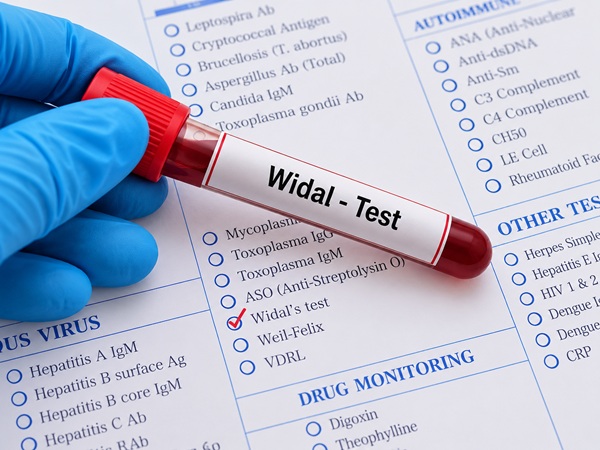
A Widal test is a blood test used to help assess a possible typhoid fever infection. Understanding the Widal test normal range, test values, and a positive or negative report can help you know what your results may indicate. However, no single Widal titre confirms or rules out typhoid on its own. A doctor interprets the result alongside symptoms, medical history, and other tests.
Quick Answer: Widal Test Normal Range
The Widal test normal range depends on the laboratory method and the background antibody levels in the local population. In India, a titre of 1:160 or higher for S. Typhi O and H antibodies may be considered suggestive of infection in some settings, but there is no single normal range that applies everywhere. A positive result alone cannot confirm typhoid fever.
What Is the Widal Test Full Form?
The Widal test is a blood test that detects antibodies against certain antigens of Salmonella bacteria, which can cause typhoid and paratyphoid fever. The test is named after Georges-Fernand Widal, the physician associated with its development.
The Widal Test full form is commonly given as the Widal test or Widal agglutination test. It is not an abbreviation formed from the initial letters of a phrase.
Doctors may recommend this test when a person has symptoms such as persistent fever, weakness, headache, stomach discomfort, or loss of appetite. The result helps with clinical assessment but should not be used alone to diagnose typhoid.
What Is the Normal Range of the Widal Test?
There is no universally accepted Widal test normal range for every person in India. The interpretation depends on the test method, local background antibody levels, symptoms, and the laboratory's reference values.
The following table gives an illustrative guide to commonly discussed titre levels. It is not a universal diagnostic chart.
|
Widal titre |
General interpretation |
|---|---|
|
1:20 or 1:40 |
May reflect low-level antibodies or background exposure |
|
1:80 |
Requires interpretation according to the laboratory's reference range and symptoms |
|
1:160 |
May be considered significant in some settings and requires medical evaluation |
|
1:320 or higher |
May raise greater concern, but does not independently confirm typhoid |
Important: A titre is the dilution at which antibodies in the blood sample continue to react with the test antigen. A higher titre may indicate a stronger antibody response, but it does not automatically mean a more severe infection.
The report's reference range should always be considered. In areas where typhoid is common, healthy people may also have antibodies due to earlier exposure or vaccination.
Is the Widal Test Normal Range Different for Male and Female?
No. There is no standard separate Widal test normal range for males and females. The interpretation is based on antibody titres, the testing method, local background antibody levels, and clinical findings rather than sex alone.
Children and adults may both undergo Widal testing when clinically appropriate, but their results should be assessed by a healthcare professional according to the patient's age, symptoms, and medical history.
What Do O and H Mean in a Widal Test?
A Widal report commonly includes O and H antibody results. These refer to different antigens associated with Salmonella bacteria.
|
Report parameter |
Meaning |
What it may indicate |
|---|---|---|
|
TO |
S. Typhi O antigen |
Antibodies associated with the O antigen; may be relevant in suspected current infection |
|
TH |
S. Typhi H antigen |
Antibodies associated with the H antigen; may remain detectable after previous infection or vaccination |
|
AH |
S. Paratyphi A H antigen |
Antibodies against the H antigen of S. Paratyphi A |
|
BH |
S. Paratyphi B H antigen |
Antibodies against the H antigen of S. Paratyphi B |
O and H results must be interpreted together with the patient's symptoms and the laboratory's criteria. Neither a single O titre nor a single H titre can reliably establish whether someone currently has typhoid fever.
What Does Widal Test O and H Positive Mean?
When both O and H antibody results are reported as positive, the findings may support suspicion of an enteric fever infection in a person with compatible symptoms. However, antibodies may also be present because of previous exposure, vaccination, or cross-reactions.
A doctor may recommend a blood culture or other investigations to clarify the diagnosis. The meaning of a positive result depends on the actual titres, the timing of the illness, and the overall clinical picture.
What Does a Positive Widal Test Mean?
A Widal test positive report means that the blood sample has shown antibody reactivity at the level specified by the test method or laboratory criteria.
A positive result does not always mean that the person currently has typhoid fever. It may be associated with:
-
A current infection that needs further clinical assessment.
-
Antibodies remaining from an earlier infection.
-
Previous typhoid vaccination, particularly when interpreting H antibodies.
-
Cross-reactions or other factors that may produce a false-positive result.
For example, a person with fever and a Widal titre of 1:160 may need further investigation. The same titre in someone without symptoms may have a different significance. The number must not be interpreted in isolation.
What Does Widal Test 1:80 Positive Mean?
A Widal test result of 1:80 indicates that antibodies were detected at that dilution. Whether this is considered positive, borderline, or significant depends on the laboratory's reporting criteria and the local background antibody levels.
A result of 1:80 alone does not confirm typhoid. If you have persistent fever or other concerning symptoms, consult a doctor rather than relying only on the titre.
What Does Widal Test Weakly Positive Mean?
A weakly positive Widal test means that the sample shows a low level of antibody reactivity according to the laboratory's criteria. It may reflect background antibodies, previous exposure, or an infection that requires further assessment.
A weakly positive result neither confirms nor completely excludes typhoid fever. Your doctor may consider the duration of fever, other test results, and whether further testing is needed.
What Does a Negative Widal Test Mean?
A negative Widal test means that the antibodies measured by the test were not detected at the laboratory's specified threshold.
However, a negative Widal test does not completely rule out typhoid fever. Antibody levels may not have risen enough to be detected early in the illness. Previous antibiotic treatment and other factors can also affect results.
If fever persists or symptoms suggest an infection, medical evaluation is important even when the Widal report is negative. A doctor may recommend additional testing based on the symptoms and the stage of illness.
How to Read a Widal Test Report
Follow these steps to understand the main parts of your Widal report.
-
Check the test method: Determine whether the report describes a slide test or a tube agglutination test.
-
Review all reported titres: Look at TO, TH, AH, and BH where applicable, rather than focusing on only one value.
-
Check the laboratory's reference range: A result may be interpreted differently by different laboratories.
-
Consider your symptoms: Fever duration, abdominal discomfort, weakness, and other symptoms help guide clinical assessment.
-
Discuss further testing: Your doctor may recommend blood culture or repeat testing if the diagnosis remains uncertain.
A rising antibody titre in paired blood samples collected at different times may provide more useful information than a single result. However, testing decisions should be made by a healthcare professional.
What Causes a False-Positive Widal Test?
A false-positive Widal test occurs when the result suggests antibody reactivity even though the person does not have a current typhoid infection.
Possible reasons include:
-
Previous typhoid infection.
-
Typhoid vaccination.
-
Cross-reactivity with other infections.
-
Naturally occurring background antibodies in the local population.
-
Limitations of the test method.
These factors are important in India, where background antibody levels can vary between regions. This is one reason why doctors do not rely on a single Widal result to make a definitive diagnosis.
Which Test Is More Reliable for Confirming Typhoid?
Blood culture is the preferred method for diagnosing acute typhoid fever because it aims to identify the bacteria causing the infection. A Widal test detects the body's antibody response instead, so it cannot reliably distinguish a current infection from previous exposure.
Blood culture can sometimes be negative even when typhoid is present. The timing of sample collection and previous antibiotic use may affect its ability to detect the bacteria. A doctor decides which investigations are appropriate based on the clinical situation.
When Should You Consult a Doctor?
Seek medical advice if you have persistent fever, worsening weakness, abdominal pain, repeated vomiting, or other symptoms that concern you. Do not start antibiotics or change prescribed treatment based only on a Widal test result.
Seek urgent medical care if you experience severe abdominal pain, confusion, fainting, significant bleeding, or difficulty staying hydrated. These symptoms can indicate a serious condition that needs prompt assessment.
Frequently Asked Questions About the Widal Test
1. What is the normal Widal test value in India?
There is no single normal Widal test value for all of India. Some laboratories consider titres of 1:160 or higher significant, while other cut-offs may apply depending on local background antibody levels and the test method. Always follow the laboratory's reference range and your doctor's interpretation.
2. What does a Widal test positive report mean?
A positive Widal report indicates antibody reactivity against the tested antigens. It may support suspicion of typhoid fever in someone with compatible symptoms, but it can also result from previous infection, vaccination, or cross-reactivity. A positive result alone cannot confirm an active infection.
3. Does a Widal test titre of 1:160 mean typhoid?
A titre of 1:160 may be considered significant in some settings, particularly when a person has symptoms consistent with typhoid. However, the result is not definitive. A doctor may recommend a blood culture and other assessments before determining the diagnosis and treatment.
4. What does Widal test negative mean?
A negative Widal test means that the tested antibodies were not detected at the laboratory's specified threshold. It does not completely rule out typhoid, especially during the early stages of illness. Persistent fever or worsening symptoms should be assessed by a healthcare professional.
5. What is the difference between O and H in the Widal test?
O and H refer to different antigens associated with Salmonella. O antibodies may be relevant when assessing a suspected current infection, while H antibodies can remain detectable after previous infection or vaccination. Both results require interpretation alongside symptoms and other clinical findings.
6. Can a Widal test be positive without typhoid fever?
Yes. Previous infection, vaccination, naturally occurring antibodies, and cross-reactions can cause a positive result in someone who does not have an active typhoid infection. This is why a doctor considers the complete clinical picture instead of relying on one antibody titre.
7. Which test confirms typhoid fever?
Blood culture is the preferred diagnostic method for acute typhoid fever because it aims to identify the bacteria responsible for the infection. Its accuracy can be affected by sample timing and prior antibiotic use. Your doctor will determine whether blood culture or additional investigations are needed.
Conclusion
The Widal test helps assess antibody responses associated with typhoid and paratyphoid fever. Understanding the Widal test normal range, O and H titres, and positive or negative results can help you read your laboratory report more confidently.
However, there is no universal Widal titre that confirms typhoid in every patient. A positive result does not always mean an active infection, and a negative result does not completely rule one out. Consult a qualified healthcare professional for accurate interpretation and appropriate treatment.
Get Your Blood Tests Done with Max Lab
If your doctor has recommended testing for a suspected infection, Max Lab can help you explore available laboratory testing services and book relevant blood tests. Visit the Max Lab website to check test availability and booking options. Follow your doctor's advice on the appropriate test and next steps.


















 To reach our help desk call 7982100200
.png)