









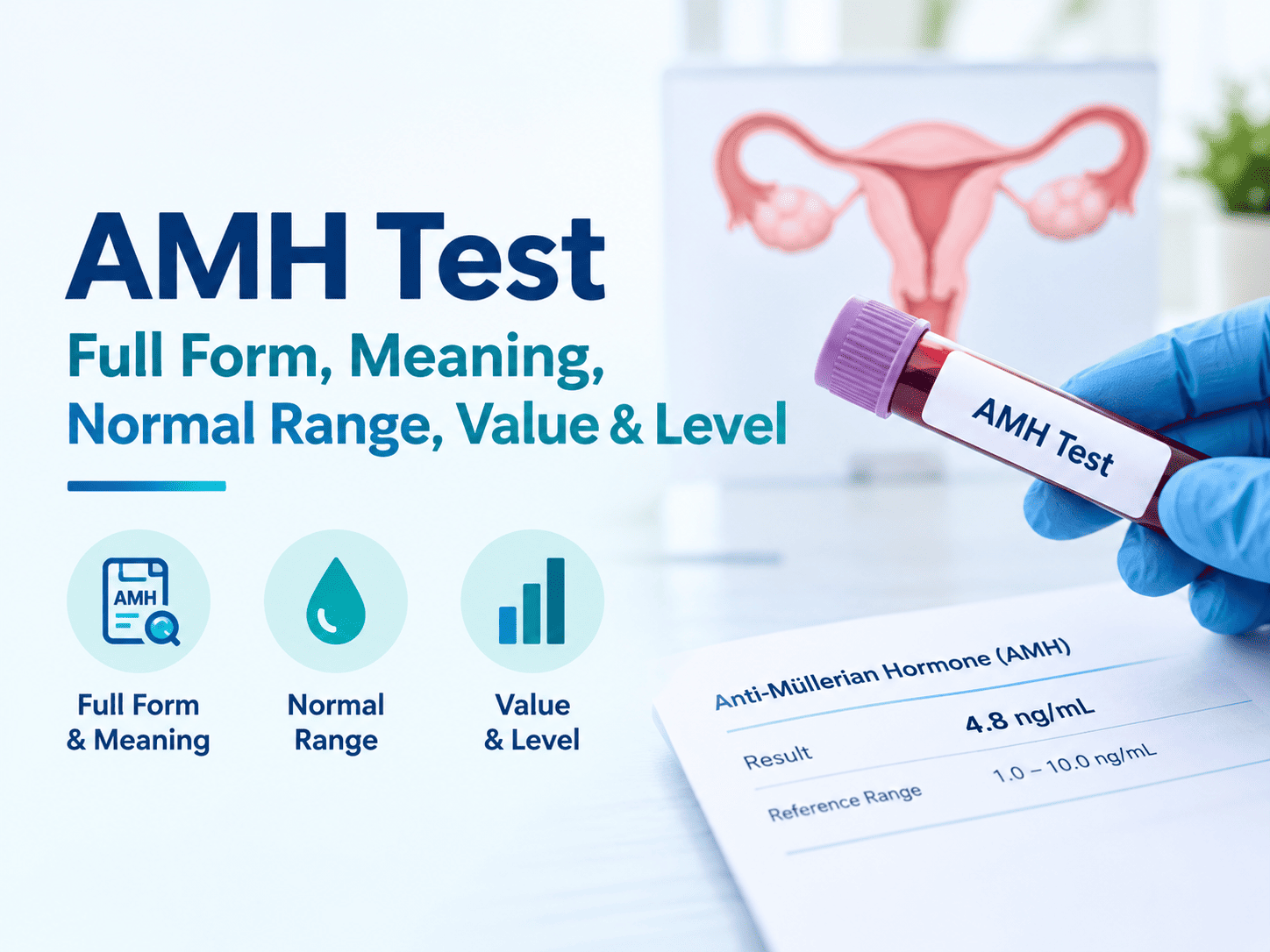
The AMH test is a blood test that measures the level of Anti-Müllerian Hormone in the blood. It is mainly used to understand ovarian reserve, which means the number of eggs remaining in the ovaries. The result can help doctors during fertility evaluation and treatment planning.
What Is the AMH Test?
The AMH test measures the amount of Anti-Müllerian Hormone in a blood sample. In women, AMH is made by small follicles in the ovaries. The amount of AMH can give an idea about the number of eggs remaining in the ovaries. AMH levels usually decrease as age increases.
What Is the Full Form of AMH?
AMH stands for Anti-Müllerian Hormone.
AMH is a hormone made by the ovaries in women. It is linked with the small follicles that contain immature eggs. Doctors may check AMH when they want to understand a woman's ovarian reserve or plan fertility treatment.
Why Is the AMH Test Done?
The AMH test is mainly done to get information about ovarian reserve. It may be recommended during a fertility evaluation or before some fertility treatments. It can also help doctors understand how the ovaries may respond to fertility medicines.
An AMH test may be advised when:
- A woman is having difficulty getting pregnant
- Fertility treatment is being planned
- Ovarian reserve needs to be checked
- There is a concern about ovarian function
- PCOS is being evaluated along with other findings
What Does the AMH Test Tell You?
The AMH test gives an estimate of ovarian reserve, or the number of eggs that may remain in the ovaries. It does not tell the exact number of eggs and does not measure egg quality.
A low AMH level may suggest a lower ovarian reserve, while a higher level may indicate a larger ovarian reserve. Your doctor will consider the result with your age and other fertility tests.
What Is the Normal AMH Range?
There is no single normal AMH range for every woman. AMH levels naturally change with age, and different laboratories may use different testing methods and reference ranges.
In general, AMH levels are higher during the reproductive years and gradually decrease with age. Therefore, your report's reference range should be used when understanding your result.
What Is a Normal AMH Level by Age?
AMH levels usually change as a woman gets older. The level is generally higher in younger women and slowly decreases with age as the number of ovarian follicles decreases.
Because AMH values can vary between people and laboratories, age-specific numbers should not be used alone to judge fertility. Your doctor can explain whether your result is expected for your age.
AMH Level by Age – General Understanding
| Age | General trend |
|---|---|
| 20–25 years | AMH is generally higher |
| 26–30 years | Levels may start to gradually change |
| 31–35 years | AMH may continue to decrease |
| 36–40 years | A further decrease may occur |
| 41+ years | AMH is generally lower |
These are general age trends, not fixed normal values. Individual AMH results can be different.
What Does a Low AMH Level Mean?
A low AMH level may indicate a lower ovarian reserve. This means the number of eggs remaining in the ovaries may be lower than expected for the person's age.
A low AMH result does not mean that pregnancy is impossible. It also does not measure egg quality. Your doctor may use AMH along with other fertility tests to understand your overall reproductive health.
What Does a High AMH Level Mean?
A high AMH level may be linked with a larger number of small ovarian follicles. High AMH levels can also be seen in some women with polycystic ovary syndrome (PCOS).
However, a high AMH level alone cannot diagnose PCOS. Doctors consider symptoms, medical history and other test results before making a diagnosis.
What Does an AMH Value Mean?
Your AMH value shows the amount of Anti-Müllerian Hormone measured in your blood. It is usually reported in ng/mL, although the unit can vary by laboratory.
The value should be compared with the reference range given on your report. Your age, symptoms, medical history and other fertility tests are also important when understanding the result.
Is AMH a Fertility Test?
The AMH test can provide useful information about ovarian reserve, but it is not a complete fertility test.
AMH does not directly measure egg quality and cannot tell with certainty whether or when a woman will become pregnant. Doctors usually use AMH together with other information when evaluating fertility.
Can AMH Test Tell If I Can Get Pregnant?
No. The AMH test cannot tell whether you will definitely get pregnant.
AMH mainly provides information about ovarian reserve. Fertility depends on many factors, including age, egg quality, ovulation, fallopian tube health, sperm health and other medical factors.
Therefore, an AMH result should not be used alone to predict pregnancy.
Is AMH Test Used for Pregnancy?
The AMH test is not a pregnancy test. It does not tell whether you are currently pregnant.
It may be used during a fertility evaluation to understand ovarian reserve and may help doctors plan certain fertility treatments. If you want to check pregnancy, a doctor may recommend a pregnancy test such as a blood or urine hCG test.
Can AMH Test Be Done During Any Day of the Period?
AMH can generally be measured at different times during the menstrual cycle, unlike some other hormone tests that are commonly checked on a specific cycle day.
However, your doctor may recommend a particular day depending on the other tests being done as part of your fertility evaluation. Follow the instructions given by your doctor or laboratory.
Is Fasting Required for the AMH Test?
Usually, fasting is not required for an AMH test.
You can generally have the blood sample collected without skipping food. However, if your doctor has prescribed other blood tests along with AMH, those tests may have different preparation requirements.
Always follow the instructions given by your doctor or laboratory.
How Is the AMH Test Done?
The AMH test is a simple blood test. A healthcare professional collects a small blood sample from a vein in your arm using a sterile needle.
The sample is then sent to the laboratory for testing. Blood collection usually takes only a few minutes. You may feel a small prick when the needle is inserted.
What Can Affect AMH Levels?
AMH levels naturally change with age. They can also vary between individuals and between laboratory testing methods.
Certain health conditions and treatments can also affect AMH levels. This is why one AMH result should be interpreted along with your age, medical history and other test results rather than being viewed alone.
What Happens If AMH Is Low?
If your AMH level is low, your doctor may look at your age, menstrual history and other fertility test results. Depending on your situation, additional tests may be suggested to understand your ovarian reserve and fertility options.
A low AMH result does not mean that pregnancy is impossible. It is one part of a complete fertility assessment.
What Happens If AMH Is High?
If your AMH level is high, your doctor may consider your symptoms and other test results. A high level can occur when there are more small follicles in the ovaries and may also be seen with PCOS.
AMH alone cannot diagnose PCOS, so other clinical findings are needed.
Does AMH Decrease With Age?
Yes, AMH generally decreases with age.
This happens because the number of follicles in the ovaries decreases over time. AMH levels are therefore usually higher earlier in the reproductive years and lower as a woman gets older.
However, the rate of change is different for each person.
Can AMH Predict Menopause?
AMH levels usually decrease as menopause approaches, but an AMH test cannot accurately tell when menopause will happen.
If you have concerns about early or premature menopause, your doctor may consider AMH along with your symptoms, menstrual history and other hormone tests.
How Long Does the AMH Test Take?
The blood sample collection usually takes only a few minutes. The time needed to receive the report can vary depending on the laboratory and testing process.
Check the test details at the time of booking for the expected report time.
Max Lab: How Can We Help?
If your doctor has advised an AMH test, you can book the test with Max Lab. You can check the test details, availability and AMH test price for your location before booking.
Max Lab offers convenient diagnostic testing and sample collection options based on location and service availability.
Frequently Asked Questions About AMH Test
What is the AMH test full form?
The full form of AMH is Anti-Müllerian Hormone. It is a hormone mainly used to understand ovarian reserve in women.
What is the meaning of the AMH test?
The AMH test measures the amount of Anti-Müllerian Hormone in the blood. It mainly provides information about ovarian reserve.
What is a normal AMH level?
There is no single normal AMH level for everyone. The result can vary with age, individual factors and the laboratory's testing method.
What does a low AMH level mean?
A low AMH level may indicate a lower ovarian reserve. It does not mean that pregnancy is impossible.
What does a high AMH level mean?
A high AMH level may indicate a larger number of small ovarian follicles. It can also be seen in some women with PCOS.
Is AMH a pregnancy test?
No. AMH is not a pregnancy test. It is mainly used to assess ovarian reserve.
Can I get pregnant with low AMH?
A low AMH level does not mean that you cannot get pregnant. AMH is only one part of a fertility assessment.
Does AMH test require fasting?
Usually, no fasting is required for an AMH test.
Can AMH test be done during periods?
AMH can generally be tested at different points in the menstrual cycle. Your doctor may advise a specific time based on your overall fertility evaluation.
What is the AMH test price?
The AMH test price can vary based on location and laboratory. Check the current price on the Max Lab booking page before scheduling the test.
Does AMH decrease with age?
Yes. AMH generally decreases with age as the number of follicles in the ovaries decreases.
Can AMH tell egg quality?
No. AMH mainly gives information about ovarian reserve. It does not directly measure the quality of the eggs.
Can AMH test confirm PCOS?
No. A high AMH level alone cannot confirm PCOS. Doctors use symptoms, medical history and other test results for diagnosis.


















 To reach our help desk call 7982100200
.png)
Comments