








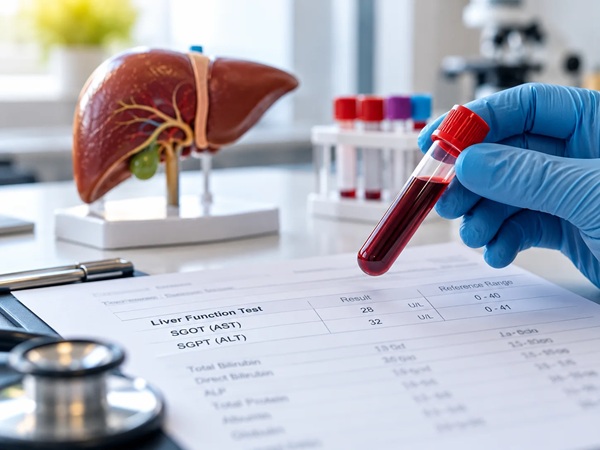

Seeing SGPT or SGOT marked high on a blood report is worrying, and most people's first thought is serious liver damage. Usually it isn't. Mild rises are common and can be temporary, but even a small rise is worth discussing with your doctor. Some levels, and some symptoms, need quick attention.
What Are SGPT and SGOT?
SGPT (also called ALT, alanine aminotransferase) and SGOT (also called AST, aspartate aminotransferase) are enzymes that work inside cells. When those cells are inflamed or damaged, the enzymes leak into the blood and the levels on your report go up. SGPT is found mainly in the liver, so a high SGPT points more clearly to a liver problem. SGOT is found in the liver too, but also in muscles, the heart and red blood cells. So a raised SGOT, especially when SGPT is normal, can sometimes come from outside the liver.
Both tests show cell injury, not how well your liver is working. That's why doctors read them alongside bilirubin, albumin and the other results in a liver function test (LFT).
What Are the Normal SGPT and SGOT Levels?
Ranges vary from lab to lab, partly because of the testing method used. As a rough guide for adults:
|
Test |
Typical range |
|
SGPT (ALT) |
About 7 to 56 U/L |
|
SGOT (AST) |
About 8 to 48 U/L |
Women usually have slightly lower values than men. Always go by the range printed on your own report, as each lab sets its own.
Some gastroenterologists now suggest that a truly healthy SGPT is lower than many labs print, around 29 to 33 U/L in men and 19 to 25 U/L in women. So a value just under your lab's upper limit isn't automatically ideal, especially if you have diabetes, obesity or fatty liver.
What Is the Danger Level of SGPT and SGOT?
There's no single number that's dangerous for everyone. Instead, doctors look at how many times higher than the upper limit of normal your result is. The American College of Gastroenterology grades it like this:
|
Grade |
How high (example if your lab's upper limit is 40 U/L) |
Common causes and what to do |
|
Borderline |
Above your lab's limit but less than 2 times (41 to 79 U/L) |
Fatty liver, alcohol, medicines or a recent hard workout. Your doctor may repeat the test or add others |
|
Mild |
2 to 5 times (80 to 200 U/L) |
Fatty liver, alcohol, medicines, long-standing hepatitis B or C. Needs a check for the cause |
|
Moderate |
Over 5, up to 15 times (201 to 600 U/L) |
Recent viral hepatitis or liver injury from medicines or herbal products. Needs prompt tests |
|
Severe |
More than 15 times (601 to 10,000 U/L) |
Acute hepatitis, paracetamol overdose or a sudden drop in blood flow to the liver. Needs same-day medical care |
|
Massive |
Above 10,000 U/L |
Usually paracetamol poisoning or shock liver. A medical emergency |
These bands are only a guide, based on a limit of 40, so check the limit on your own report. The same condition can cause different levels, and the number alone doesn't show how damaged the liver is. Three other things matter just as much:
-
Symptoms. Yellow eyes, confusion or unusual bleeding make even a mild rise urgent.
-
The trend. A level that keeps rising, or stays high for months, needs more tests even if it's only mildly raised.
-
Your other results. A raised bilirubin or a prolonged PT/INR can mean the liver isn't working as well, though there are other causes too, so your doctor will look at them together.
A higher number doesn't always mean worse disease. In cirrhosis, SGPT and SGOT can be only mildly raised, or even normal, because fewer healthy liver cells are left to release them.
What Does the SGOT/SGPT Ratio Tell You?
In most liver conditions, SGPT is higher than SGOT. When SGOT is more than twice SGPT, alcohol-related liver disease becomes more likely, though advanced scarring (cirrhosis) from other causes can show the same pattern. It's a clue, not a diagnosis.
A high SGOT with a normal SGPT may come from muscle, for example after heavy exercise or a muscle injury. A creatine kinase (CK) blood test can check for this.
Common Causes of High SGPT and SGOT
In India, the most common causes are:
-
Fatty liver. A 2022 review of Indian studies found it in about 39% of the adults studied, about 28% in average-risk groups and about 53% in higher-risk groups such as people with obesity or diabetes. Figures varied a lot between studies.
-
Alcohol, even at amounts many people think of as social drinking.
-
Viral hepatitis. Hepatitis A and E spread through contaminated food and water. Hepatitis B and C spread through blood and body fluids.
-
Medicines, both prescribed and bought over the counter, such as high doses of paracetamol, TB medicines, some antibiotics, seizure medicines and statins. Statins are still safe for most people, so don't stop any medicine without asking your doctor.
-
Herbal, Ayurvedic and bodybuilding supplements, which can injure the liver.
-
Hard exercise or a muscle injury, which mainly raises SGOT.
-
Less common causes, such as thyroid problems, celiac disease, autoimmune hepatitis and Wilson disease, which are usually looked for when a rise doesn't settle.
Symptoms of High SGPT and SGOT Levels
Raised enzymes don't cause symptoms by themselves, and many people feel completely well. When symptoms do appear, they come from the underlying problem:
-
Tiredness and weakness
-
Loss of appetite, nausea or vomiting
-
Pain, tenderness or a dull ache in the upper right side of the belly
-
Dark, tea-coloured urine or pale, clay-coloured stools
-
Yellowing of the whites of the eyes or the skin (jaundice)
-
Itching without a rash
-
Swelling of the belly, legs or ankles
SGPT and SGOT in Pregnancy
A normal pregnancy doesn't usually raise SGPT or SGOT, so a raised result during pregnancy needs prompt review by your obstetrician. The likely cause depends on the stage of pregnancy:
-
Severe vomiting in early pregnancy (hyperemesis gravidarum)
-
Itching, especially of the palms and soles, in the second half of pregnancy (intrahepatic cholestasis of pregnancy), which needs a bile acid test because SGPT and SGOT can still be normal
-
High blood pressure with liver involvement, such as pre-eclampsia or HELLP syndrome, late in pregnancy
-
Acute fatty liver of pregnancy, a rare but serious condition in the last trimester
-
Viral hepatitis, including hepatitis E, which can be especially serious in pregnant women
Get same-day care for raised liver enzymes in pregnancy along with a severe headache, blurred vision, upper belly pain, persistent vomiting or yellow eyes.
Which Tests Are Done When SGPT and SGOT Are High?
For a mild rise, your doctor will first ask about symptoms, medicines, alcohol and your other results. A repeat test is often done to confirm the rise, and more tests are added depending on what they find. If you have symptoms, or levels stay high or are moderately or severely raised, your doctor will look for the cause straight away with tests such as:
-
A full liver function test, including bilirubin, alkaline phosphatase, GGT and albumin
-
PT/INR, to check how well the liver makes clotting proteins
-
A complete blood count (CBC), including platelets
-
Hepatitis tests: HBsAg for hepatitis B, anti-HCV for hepatitis C, and IgM tests for hepatitis A and E if the illness is recent
-
Ultrasound of the abdomen, to look for fatty liver, gallstones, a blocked bile duct or other changes
-
Blood sugar, lipid profile and thyroid tests
-
CK, if a muscle cause is suspected
-
FibroScan or a FIB-4 score (worked out from your age, SGOT, SGPT and platelet count), to check for liver scarring, which SGPT and SGOT alone can't show
You don't need to fast for a liver function test. Do avoid a heavy workout for a day or two before, and tell us about all the medicines and supplements you take.
How Can High SGPT and SGOT Levels Be Managed?
Treatment depends on the cause. Your doctor may advise:
-
Stopping alcohol completely if it's the cause.
-
Losing weight, cutting sugar and refined carbs and exercising regularly for fatty liver. Even a modest weight loss can bring the enzymes down.
-
Changing or stopping a medicine, but only on your doctor's advice.
-
Telling your doctor about every supplement you take, and stopping any that could harm the liver.
-
Antiviral treatment for hepatitis B or C.
-
Keeping diabetes, cholesterol and blood pressure under control.
-
Vaccination against hepatitis A and B if you aren't already protected.
When Should You See a Doctor?
See your doctor soon if:
-
Your SGPT or SGOT is above the range on your report, even if you feel fine
-
It's still high on a repeat test
-
You notice new yellowing of your eyes or skin (go the same day)
-
Bruises appear easily or for no clear reason
-
You have diabetes or obesity, drink alcohol regularly or take long-term medicines
-
You're pregnant
Get emergency care straight away if a raised level comes with:
-
Confusion, unusual sleepiness or a change in behaviour
-
Vomiting blood or black, tarry stools
-
Heavy bleeding that won't stop
-
Severe belly pain or a belly that swells up quickly
-
A possible paracetamol overdose, even if you feel well
Not sure what your SGPT and SGOT levels mean? Book a liver function test with Max Lab and go over the results with your doctor.


















 To reach our help desk call 7982100200
.png)