









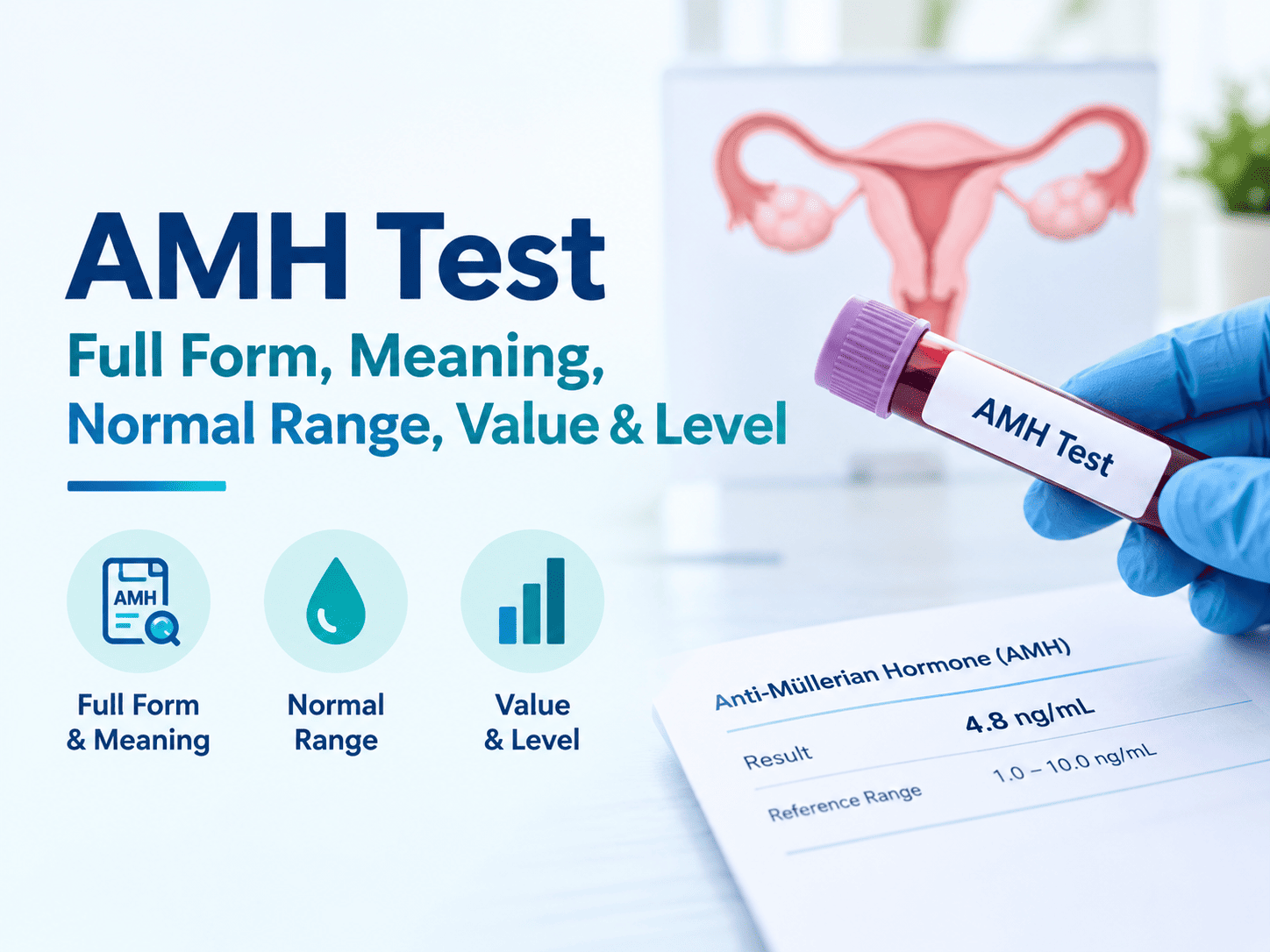
The AMH normal range in male and female depends on age, sex, and the reason for testing. Anti-Müllerian hormone (AMH) is commonly used to assess ovarian reserve in females, while in males it plays a role in reproductive development and certain fertility evaluations. AMH levels must be interpreted using age-specific and laboratory-specific reference ranges.
What Is the AMH Normal Range?
The AMH test measures Anti-Müllerian hormone in the blood. In females, it helps estimate the number of eggs remaining in the ovaries, known as ovarian reserve. It does not directly measure egg quality or guarantee the ability to become pregnant.
In males, AMH has a different role and may be measured in specific reproductive or developmental evaluations.
AMH Normal Range in Females
AMH levels vary with age and generally decline as females get older. The following values are broad examples sometimes used in adult fertility assessments, not universal reference ranges.
| AMH Level | General Interpretation |
|---|---|
| Below 1.0 ng/mL | May indicate lower ovarian reserve |
| 1.0–3.5 ng/mL | Often seen as a typical range in fertility assessments |
| Above 3.5 ng/mL | May indicate higher ovarian reserve; sometimes associated with PCOS |
Note: AMH ranges vary considerably by age, assay, and clinic. A high or low result alone cannot diagnose a condition or predict natural pregnancy.
AMH Normal Range in Males
There is no single AMH reference range that applies to all males. AMH levels are particularly high during childhood and change as reproductive development progresses. In adult males, AMH may be measured in selected evaluations of testicular function or reproductive development. The result should be compared with age-specific laboratory ranges.
What Does a High or Low AMH Value Mean?
Low AMH Level
In adult females, a low AMH level may suggest reduced ovarian reserve. It does not mean pregnancy is impossible, and it cannot predict exactly when menopause will occur.
High AMH Level
A high AMH level may indicate a higher number of small ovarian follicles. It can be associated with polycystic ovary syndrome (PCOS), but AMH alone cannot confirm PCOS.
In males, AMH results have different meanings and must be interpreted according to age and the reason for testing.
When Should You Get an AMH Test?
A doctor may recommend an AMH test when assessing ovarian reserve, planning fertility treatment, investigating certain reproductive concerns, or evaluating specific reproductive development conditions. Your healthcare professional may interpret the result alongside age, menstrual history, ultrasound findings, and other hormone tests.
Frequently Asked Questions About AMH Normal Range
1. What is the normal AMH range in females?
There is no single normal AMH value for every female. Levels depend on age and the laboratory method. A fertility specialist can interpret the result using age-specific reference ranges.
2. What is the normal AMH range in males?
AMH reference ranges in males vary significantly with age and developmental stage. The laboratory's age-specific reference interval should be used.
3. What does a low AMH level mean?
In adult females, low AMH may indicate reduced ovarian reserve. It does not establish infertility or mean that natural pregnancy cannot occur.
4. What does a high AMH level mean?
High AMH may indicate a greater number of small ovarian follicles and can be associated with PCOS. Other clinical findings are needed to assess the cause.
5. Does AMH decrease with age?
Yes. In females, AMH generally declines with age as ovarian reserve decreases. The rate of decline differs from person to person.
6. Can AMH predict pregnancy?
AMH can help estimate ovarian reserve and predict response to some fertility treatments, but it cannot reliably predict whether or when an individual will become pregnant naturally.
7. Is fasting required for an AMH test?
Fasting is generally not required for an AMH blood test. Follow your laboratory's instructions if other tests are being performed at the same time.
8. Can AMH levels diagnose PCOS?
No. AMH may support a PCOS assessment in selected adults, but it should not be used alone to diagnose the condition.
Conclusion
The AMH normal range in male and female varies with age, sex, reproductive development, and laboratory method. In females, AMH helps estimate ovarian reserve but cannot independently determine fertility. In males, it has a different clinical role. Discuss your AMH result with a healthcare professional for an accurate interpretation.


















 To reach our help desk call 7982100200
.png)